History
The Sydney Opera House — from audacious concept to world cultural icon
While many know the Sydney Opera House as one of the world's most iconic buildings, few understand the long and tumultuous journey behind it. Its rich and complicated history spans decades, involves numerous influential figures, includes the creation of new engineering technologies, and culminates in the construction of one of the greatest buildings of the last hundred years.
From concept to reality: the competition and early years
Although the idea of a dedicated performing arts centre for Sydney had existed for decades, there had never been enough money to support such a venture. During the 1940s, Australian conductor Sir Eugene Goossens campaigned extensively for a grand opera house in Sydney, and in doing so developed the idea that Sydney should have a major cultural destination. After conducting several studies of possible sites, Goossens suggested Bennelong Point as the ideal location.
In 1954 the New South Wales Government announced that it wanted to construct a national opera house at Bennelong Point, and at the same time announced an international competition for architects to submit designs. The results were surprising. Of the 233 submissions from 32 different countries, many were traditional and practical — but one, numbered scheme 218, stood out. It was submitted by a young and relatively unknown Danish architect named Jørn Utzon.
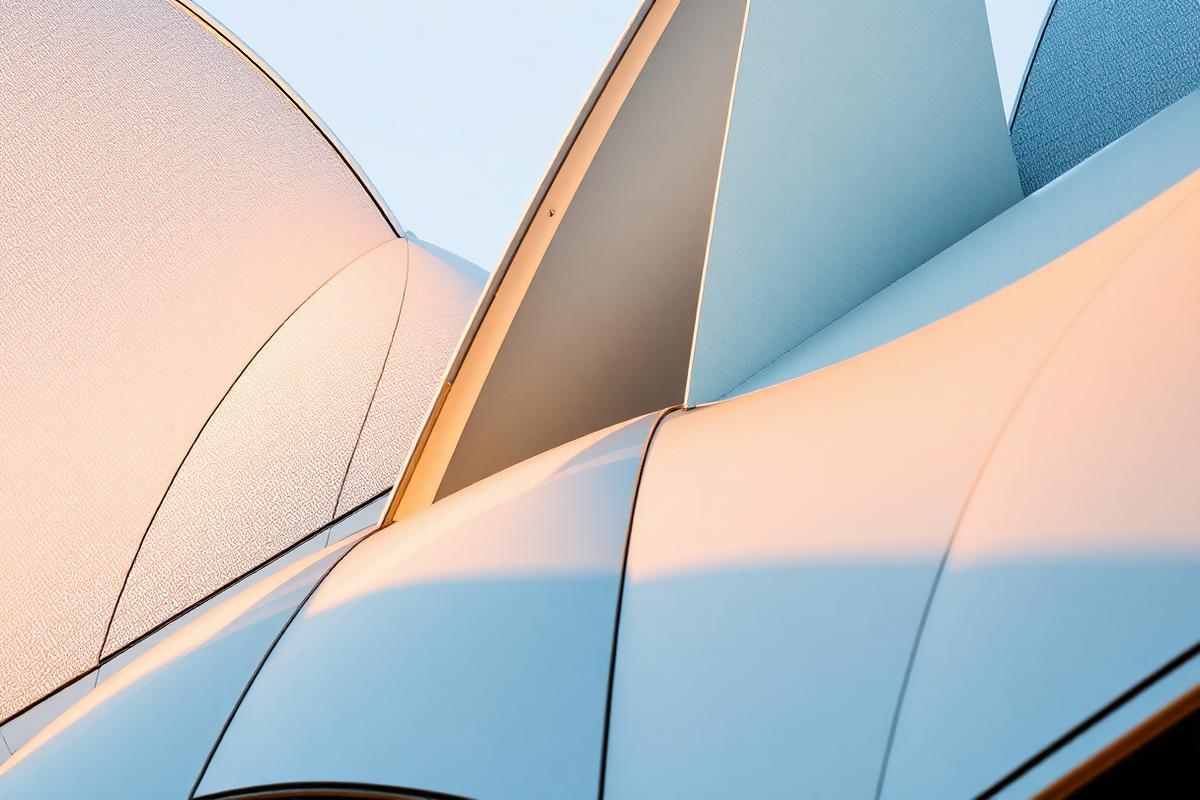
Utzon's submission consisted of only sketches and drawings depicting massive shells supported by a large podium. This design departed dramatically from anything else submitted. Utzon was not designing a building — he was creating sculpture. He wanted the structure to be an extension of the surrounding environment, imagining the shells as reminiscent of ship masts or possibly clouds. As the competition progressed, the judges began to appreciate the sculptural beauty of the design and the sheer audacity of its roof line. Ultimately, scheme 218 was declared the winner in 1957.
The judges' choice was not without controversy
Many people questioned whether Utzon's design was too extravagant or impractical. Some believed it was simply too much for engineers to accomplish. But the judges saw something special — they understood that Utzon's design was destined to be a masterpiece, and would serve as a symbol for Australia.
Utzon's design philosophy: additive growth
Utzon believed in what he called the "additive growth" philosophy — that forms grow organically, and that just as leaves grow out of a stem or branches grow off a tree, so too can we create structures that are organic and beautiful. To illustrate the theory he often used examples such as palm fronds opening up.
Overcoming the engineering obstacles
As great as Utzon's design was, it presented enormous engineering obstacles. The shapes were unlike anything built before. How could you construct something that looked like nothing? Engineers worked day after day researching new materials and developing new technology.
One of their biggest breakthroughs occurred in 1961. After years of work together, Utzon and the engineers realised that all of the shells could be drawn from the surface of a single sphere. If each shell could be replicated using only pieces of that sphere, the sections could be fabricated in advance. This changed everything. An unbuildable dream became a reality. The construction process was now broken down into three distinct phases: first, constructing the base; second, erecting the shells; third, completing the interior.
Stormy skies ahead
Although engineers overcame many technical hurdles, problems arose around politics and money. Delays mounted and costs skyrocketed. Tensions increased between Utzon and the New South Wales government. Although he was an extremely talented artist and thinker, Utzon clashed constantly with politicians who viewed themselves primarily as budget managers.
Cost estimates went from A$7 million to A$100 million over ten years, and the timeline for completion continued to slip. Finally, in 1966, funding for the project was essentially cut off, resulting in Utzon's resignation and departure from Australia that April. It remains a dark chapter in both Utzon's career and in Australian culture.
Construction completed under pressure
Following Utzon's resignation, a group of Australian architects — Peter Hall, Lionel Todd and David Littlemore — was given responsibility for finishing the interiors. The largest space originally planned for opera was converted into a concert hall, and the smallest space was designated for use as an opera and ballet hall. These alterations had serious consequences for the acoustics of both spaces, most notably resulting in less-than-ideal acoustics for opera — a problem that persists today and will likely require further renovation to improve.
On 20 October 1973, Queen Elizabeth II formally opened the Sydney Opera House. The ceremonies took place with fireworks and a live performance of Beethoven's Symphony No. 9.
Legacy and ongoing development
Since its completion, the Sydney Opera House has been recognised as one of the most successful architectural achievements of the twentieth century. On 28 June 2007 it was added to UNESCO's World Heritage list for its "outstanding universal value", acknowledged both for its innovative structural engineering and its role as an exemplar of modern architectural expression.
Efforts have been made to recognise and thank Utzon for his contribution. In 1999 the Sydney Opera House Trust engaged him again to help establish guidelines for future renovations, ensuring consistency with his original artistic intentions. In 2004 he created interior design modifications for the reception area — now known as the Utzon Room — and established an eight-page design principles document outlining preferences for any interior work moving forward. Sadly, he passed away before seeing his contribution fully implemented.
Renovations continue today, focused on improving acoustics and accessibility so the building remains a competitive, world-class performing arts venue.
Ultimately, the Sydney Opera House exists as a living testament to humanity's ability to achieve extraordinary feats through collective imagination and collaboration — a monument to human endeavour on the shores of Sydney Harbour.